height build
Height
Likely tall for his time
Jesuit and Japanese contemporary accounts highlight his unusually large stature compared with local Japanese people.
Portrait reconstruction
0–0 · Japan (originally East Africa / Portuguese Indian Ocean trade) · Azuchi–Momoyama period (late 16th century)
Yasuke was a tall, dark‑skinned African man with a broad, powerful build and short, tightly curled hair, later dressed in samurai armor and Japanese garments.
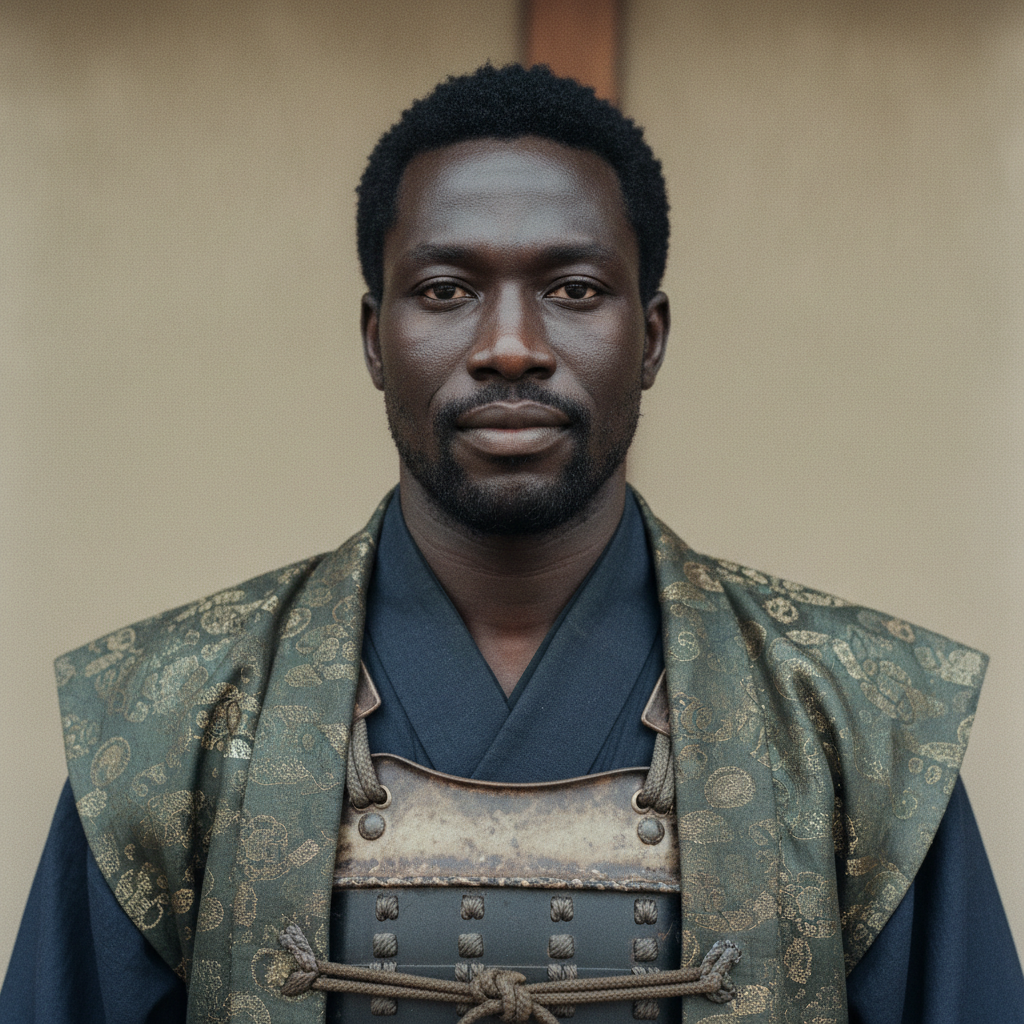
Visually, Yasuke would have registered first by his skin tone: dark brown to very dark skin that European and Japanese observers of the time singled out. Contemporary accounts describe him as unusually large for the court—a man taller and thicker than most Japanese courtiers—so imagine a solid, muscular frame and a commanding presence. His hair was likely short and tightly curled, the typical texture of many East African coastal populations, rather than a long European-style hairstyle; he was probably clean‑shaven or with minimal facial hair in keeping with samurai grooming. Facial features would have combined broad nose and full lips with strong bone structure—features noted indirectly in period descriptions of African visitors. When serving Oda Nobunaga he would most often be seen wearing Japanese dress: kabuto and armor or formal samurai garments for ceremonies, and court kimono or kimono over armor in public. Early on he may have arrived in Portuguese or African clothing, but at court he presented as a foreign warrior assimilated into samurai attire—sash, armor plates, and the weapons of a retainer—making his silhouette distinctly martial and foreign at once.
Height / build
Likely tall for his time · Likely muscular/stocky
Hair
Likely black · Likely tightly coiled / curly · Likely full, close‑cropped
Eyes
Likely dark
Complexion
Likely dark to very dark
Face
Likely broad to oval · Likely broad
Notable features
Dark skin, tall stature, muscular frame, tightly coiled black hair
Grooming
Probably minimal facial hair (sparse beard or clean‑shaven) · Short‑cropped hair and practical grooming; likely adopted some samurai styles (such as wearing a topknot when required) while serving Nobunaga.
Dress / presentation
Contemporary samurai and court retainer dress: kimono, haori, and when on duty, samurai armor suitable for a retainer
height build
Height
Likely tall for his time
Jesuit and Japanese contemporary accounts highlight his unusually large stature compared with local Japanese people.
height build
Build
Likely muscular/stocky
He served as a bodyguard and warrior; contemporary writers remark on his strength and size, implying a robust build.
skin
Complexion
Likely dark to very dark
Multiple contemporary sources explicitly describe him as a 'black' man; his origin is tied to East African/Indian Ocean ancestry.
hair
Hair texture
Likely tightly coiled / curly
Population context (East African/Portuguese Indian Ocean trade origins) and period descriptions of African visitors support tightly coiled hair as the best estimate.
hair
Hair color
Likely black
Standard for his probable ancestral background and consistent with contemporary descriptions.
eyes
Eye color
Likely dark
In late 16th‑century Japan, pale skin, straight black hair, and a composed facial bearing signaled aristocratic refinement, while physical strength and martial bearing signaled authority. Yasuke’s dark skin and large frame did not match courtly beauty ideals but served as a visible symbol of exotic prestige and martial prowess—qualities Oda Nobunaga used to project power and cosmopolitan reach.
He arrived to Japan via Portuguese/Jesuit networks from the Indian Ocean world; many candidates point to East Africa or coastal Portuguese territories (Mozambique/Swahili coast or Goa). People from these regions commonly had dark skin, black tightly curled hair, dark eyes, and robust builds—traits that match contemporary descriptions of Yasuke.
Modern media often exaggerate height, hair volume, or give him distinctly European features; historically he was African in appearance and integrated into Japanese clothing and armor.
Modern films and comics often turn Yasuke into a giant, hyper‑muscled warrior or give him distinctly European features; historically he would have looked African and adapted to Japanese dress, not as a caricatured 'black samurai' fantasy hero.
There is no universally accepted contemporary portrait; Japanese and missionary artists produced images of foreigners, but visual depictions mix artistic convention and exoticizing. So contemporary written descriptions remain the clearest direct evidence for his appearance, supplemented by population context.
Likely tall for his time — contemporary accounts stress his unusually large stature compared with Japanese people of the period.
Likely dark (brown/black), typical for East African/Indian Ocean populations.
Likely black and tightly coiled/curly; he probably kept it short for practicality and could have worn a topknot when required.
Probably minimal facial hair — contemporary sources do not emphasize a large beard.
Japanese samurai attire: kimono and court dress when at Nobunaga’s side, and samurai armor or battle clothing when serving in military contexts.
Contemporary Jesuit letters and Japanese chronicles describe his dark skin, large size, and presence at Nobunaga’s court; these texts plus knowledge of Indian Ocean populations inform reconstructions.
Letter(s) of Alessandro Valignano
Alessandro Valignano (Jesuit letters) · 1579–1580 (period)
Valignano’s reports from his visit to Japan note the presence of an African man in Nobunaga’s service and remark on his size and dark skin; these letters are early European observations of Yasuke.
Historia de Japam
Luís Fróis (Jesuit chronicle) · Late 16th century / published later
Frois, a Jesuit missionary in Japan, described Yasuke as a dark‑skinned African of remarkable size who served Nobunaga—the most detailed contemporary European narrative about Yasuke’s appearance and role.
Shinchō Kōki (The Chronicle of Lord Nobunaga)
Ōta Gyūichi (Japanese chronicle) · Early 17th century (covering late 16th c.)
Japanese chronicle entries note Yasuke’s service and presence at Nobunaga’s events; Japanese sources corroborate foreign accounts that he was an unusual, notable figure at court.
Namban (Southern Barbarian) folding screens and paintings
Japanese Namban art tradition · Late 16th–17th century
Visual depictions of Europeans and Africans in Japan show dark‑skinned foreign visitors with varied features; none is a verified life portrait of Yasuke, but they show how foreigners were depicted and dressed in Japanese art of the era.
Jesuit voyage and trade records
Portuguese Jesuit archives and mission reports · Late 16th century
Records of Portuguese and Jesuit movements in the Indian Ocean provide context for Yasuke’s probable origins and physical type (African from Portuguese trading ports).
Dark brown/black eyes are typical among East African and Indian Ocean populations; no source suggests lighter eyes.
grooming
Facial hair
Probably minimal facial hair
No strong contemporary note of a conspicuous beard; many retainers and converts among foreigners were photographed/written as clean or lightly bearded.
hair
Hairline / style
Likely full, close‑cropped; may have worn a topknot when serving
Practical short crop suits tight curls; samurai service likely required adopting local hairstyles (topknot) at times.
clothing
Clothing style
Samurai/retainer dress (kimono, armor when on duty)
He served as a retainer to Nobunaga and was recorded attending in court and battle—he would have worn contemporary samurai clothing and armor.
other
Presence in a room
Visually striking and immediately noticeable
Contemporary observers record that his color and size caused curiosity and that Nobunaga showcased him; he would draw immediate attention.